
RELEASE INFORMATION
25 JULY 2021
119.99 USD FOR ANODIZED, 99.99 USD FOR RAW
7068 ALUMINIUM
61 ANODIZED (LIGHT ORANGE / DARK ORANGE ACID WASH) AND 8 RAW MADE
Diameter 52mm, Width 40mm, Gap 4.4mM
65.5G
M4 x 10mm axle
CONCAVE C bearinG
19MM TYPE 40 LANDING PADS RESPONSE

BEGINNING OF… THE END
The success of Mecha-Bapezilla made me consider producing a more accessibly priced aluminium yo-yo, allowing a broader range of players to experience an RSO design. Sonny Patrick and I initially planned Bapezilla 3: a 54mm version of Bapezilla that weighed almost 4g less than its predecessor. Approximately a dozen prototypes were produced across both C- and D-bearing configurations, most of which were given to RSO collectors. The C-bearing prototypes were anodised in Bapezilla's familiar green and blue. The pink-and-black D-bearing versions paid tribute to the Anti-Yo Fluchs.

C bearing prototypes of the Bapezilla 3 were anodized in the standard green and blue. The D bearing ones were anodized pink and black, a tribute to the Anti-Yo Fluchs.

One D-bearing prototype was auctioned by Sonny during the Scales Collective Fundraiser for Social Justice. It raised 700 USD - the second-highest amount of the event, behind only the Scales Edition Mecha-Bapezilla.
Sonny loved Bapezilla 3. I was less convinced. Its floatier playfeel and shortened nipple had moved it away from the character of Bapezilla. The design was enjoyable, but it did not feel sufficiently distinctive for an RSO release. Bapezilla 3 therefore remained a prototype.
The search for an aluminium successor continued-and eventually led back to The End.

The Bapezilla 3 prototype (it was “Untitled” at that time) grossed the second highest amount at the Fundraiser for Social Justice auction, only second to the Scales Edition Mecha-Bapezilla.
The original End was created by Yes, Absolutely - the partnership of Doc Pop and Phil Cox-and meticulously machined by Nick Corea. It was based on the Anti-Yo Eetsit, but incorporated several modifications intended to resolve weaknesses in the original design. Only 22 were made, of which 17 were offered for sale.
At the beginning of 2021, I approached Doc Pop about revisiting the design. He agreed during our first Zoom call. Sonny Patrick and Kiya Babzani of Anti-Yo also graciously gave the project their blessing. The intention was not to replace The End. It was to understand it, preserve it and resolve the problems that had followed its original modifications.


THE END OF ALL PROBLEMS
The story begins with the Eetsit’s bearing seat. The Eetsit lacked a wall separating the bearing from the response pads. This allowed the string to slip occasionally between the bearing and the yo-yo half.

Fig. 1 Eetsit bearing seat on the left, with the pink arrow showing the point where the string tends to slip in. Modern yo-yo designs have a wall adjacent to the bearing (green arrow), preventing string slippage. CADs are not drawn to scale.
Players developed two principal workarounds.
The first involved sanding the bearing seat so that the bearing sat deeper within the yo-yo. This reduced the likelihood of string slippage, but also narrowed both the gap and the overall width.
The second involved installing thicker response pads. While simpler, this made tricks involving multiple string layers considerably more difficult.
Neither solution addressed the underlying geometry.

Fig. 2 Before and after sanding down the Eetsit bearing seat. The bearing seats deeper within the seat (red VS green rectangles).
For The End, the bearing seat was completely redesigned. The bearing was recessed more deeply, material was removed from the surrounding catch zone and two concentric cuts - Schmoove grooves - were introduced beside the bearing. These changes reduced the width from 40mm to 39mm and created the wall required to prevent string slippage. The original problem was solved.

Fig. 3 Addition of Schmoove rings to the Eetsit halves. This made the walls of the hub paper thin (blue arrow) and easily breakable.
Unfortunately, a new one was created. Removing material from around the bearing seat left the walls of the hub extremely thin, particularly around the nipple. The End could consequently be damaged by a sufficiently forceful impact. Its aggressive blasted finish also increased the risk of cutting string.

Broken OG End #2. Notice the paper thin walls.
Some serial numbers were engraved off-centre, presumably because of the difficulty of aligning the assembled yo-yo beneath the laser. The blotchy finish was imperfect, but undeniably beautiful. It gave every End a character entirely its own.

Lopsided number engraving on Bryan Figueroa’s OG End #10.

The only B grade End - Part II (Prelude) for sale, #32 with a lopsided number engraving.

Although the OG End had a blotchy and rough finish, it was beautiful.
REBUILDING THE END
The End Part II was developed by retracing Nick Corea’s work and changing only what was necessary.
The walls surrounding the hub were thickened to approximately 0.8mm. This remains thin, but provides substantially greater durability than the original geometry. To preserve the original weight, material was removed elsewhere and redistributed into the reinforced hub. The machining lines around the rims were also cleaned up.
The result is not an exact reproduction of The End. It is a careful reconstruction that retains its high-walled character, proportions and unusual playfeel while addressing its most consequential weaknesses.


A small number were kept raw and polished to a mirror finish. Their uncoated surfaces also provide a suitable canvas for custom anodisation - a fitting continuation of the original run’s distinctly unofficial character.


TRADEMARK SCHMOOVE GROOVES
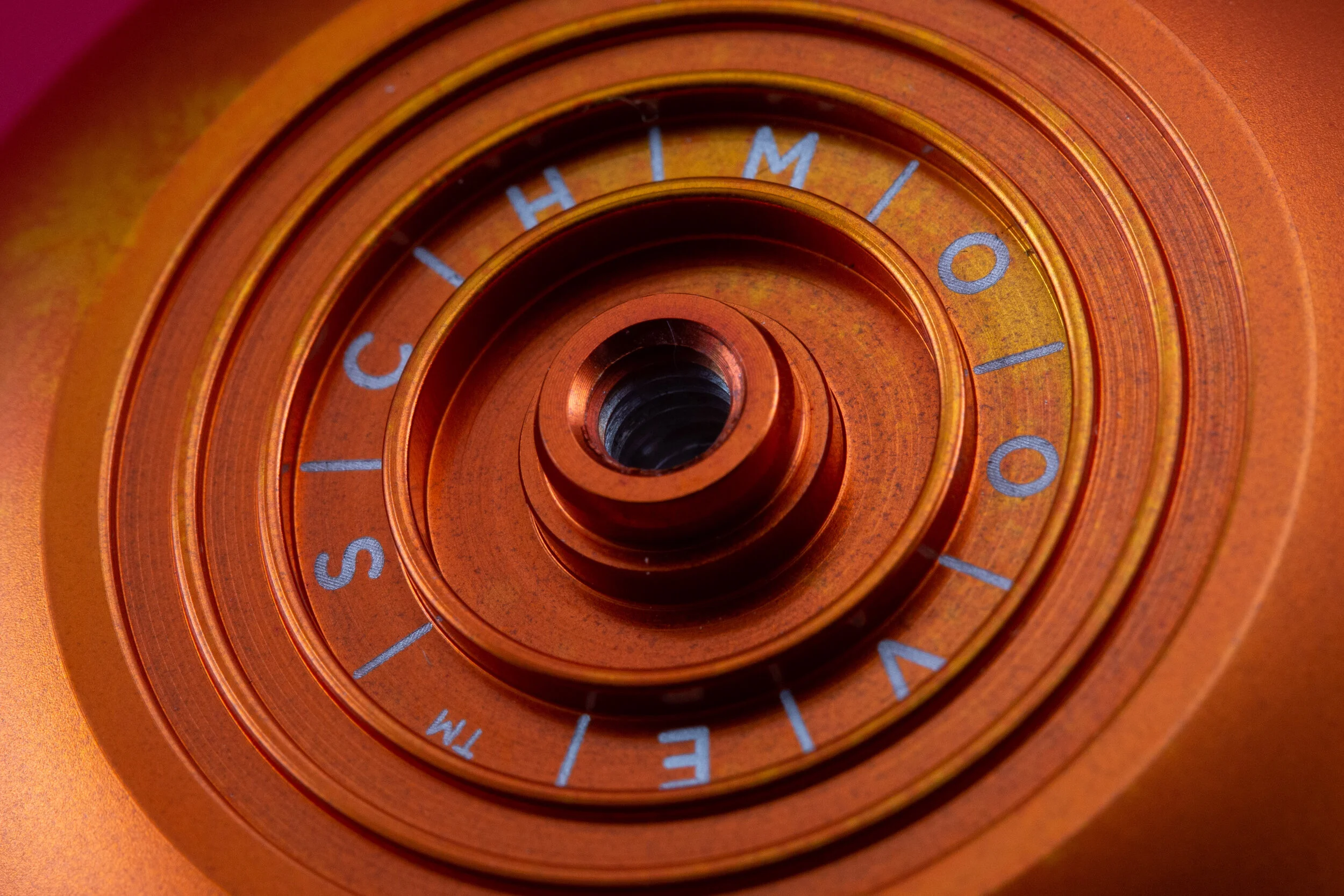
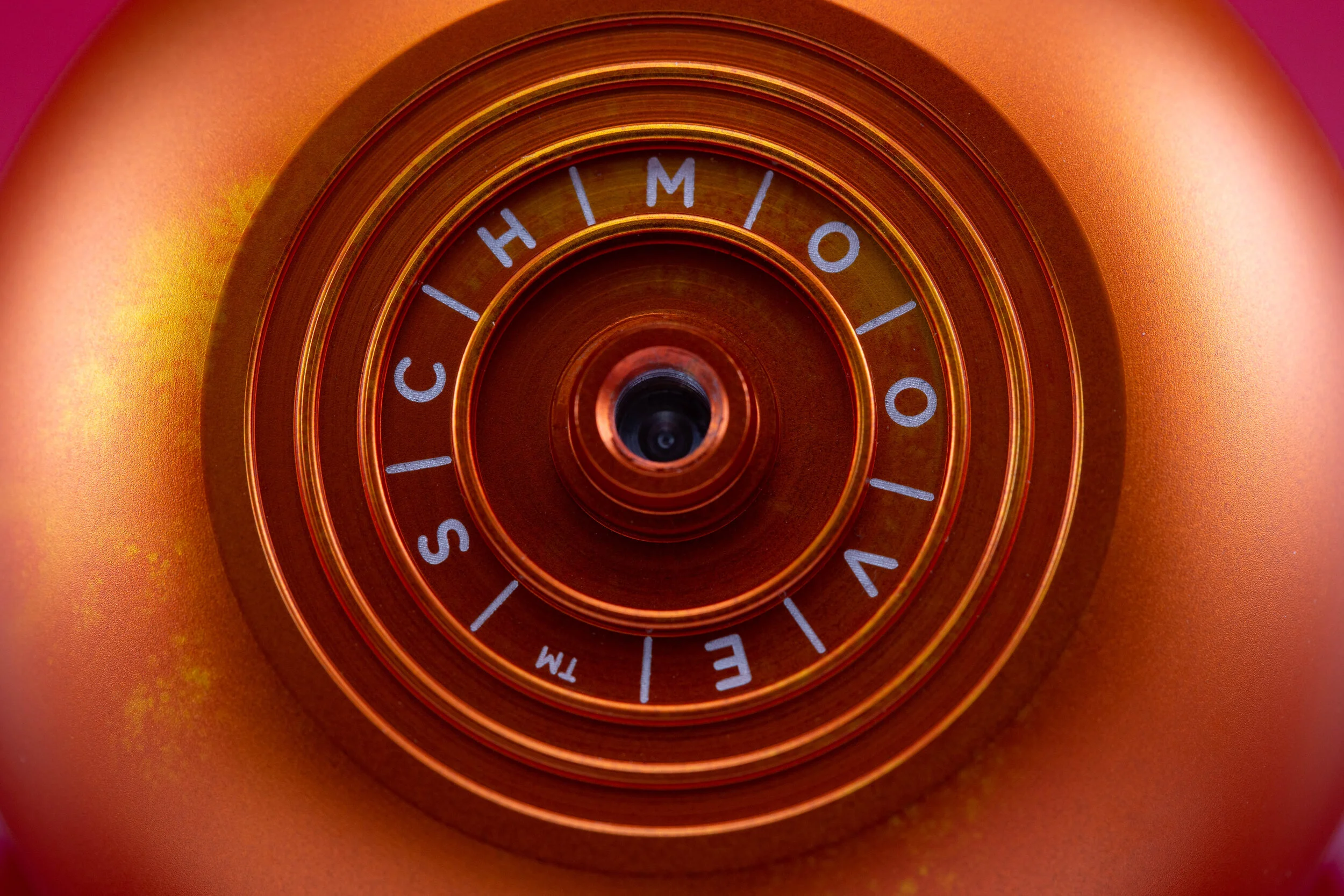
Schmoove grooves are the two recessed circular cuts positioned within the catch zone beside the bearing. They reduce the area of contact between the string and the yo-yo’s high inner walls, lowering friction during play. This is particularly important on The End, where the recessed bearing and relatively narrow gap bring the string closer to those surfaces.
The name was originally spelt “SHMOOVE”, without the letter C. “SHMOOVE” was engraved inside the response-pad groove of the original End.
For The End Part II, the spelling became “SCHMOOVE”. Reproducing this detail required two separate visits to the engraver. The internal wordmark was applied before assembly, while the exterior engraving was completed afterwards so that the graphics on both halves could be correctly aligned. It was a more complicated and expensive process. It was also the correct way to finish the job.

An OG End prototype, still in the possession of Doc Pop today.

Notice the spelling of "SHMOOVE” instead of “SCHMOOVE” on the OG End.


An email dated 20 November 2007 from Nick Corea to Doc Pop, detailing the specifications of the Schmoove Grooves.

ART BY DOC POP, COLOR BY ATILA
The name of the original yo-yo was itself a joke. Yes, Absolutely released its first design as The End, intending to follow it with The Middle and, eventually, The Beginning. Its engraving adopted the pixelated visual language of video games from that period.
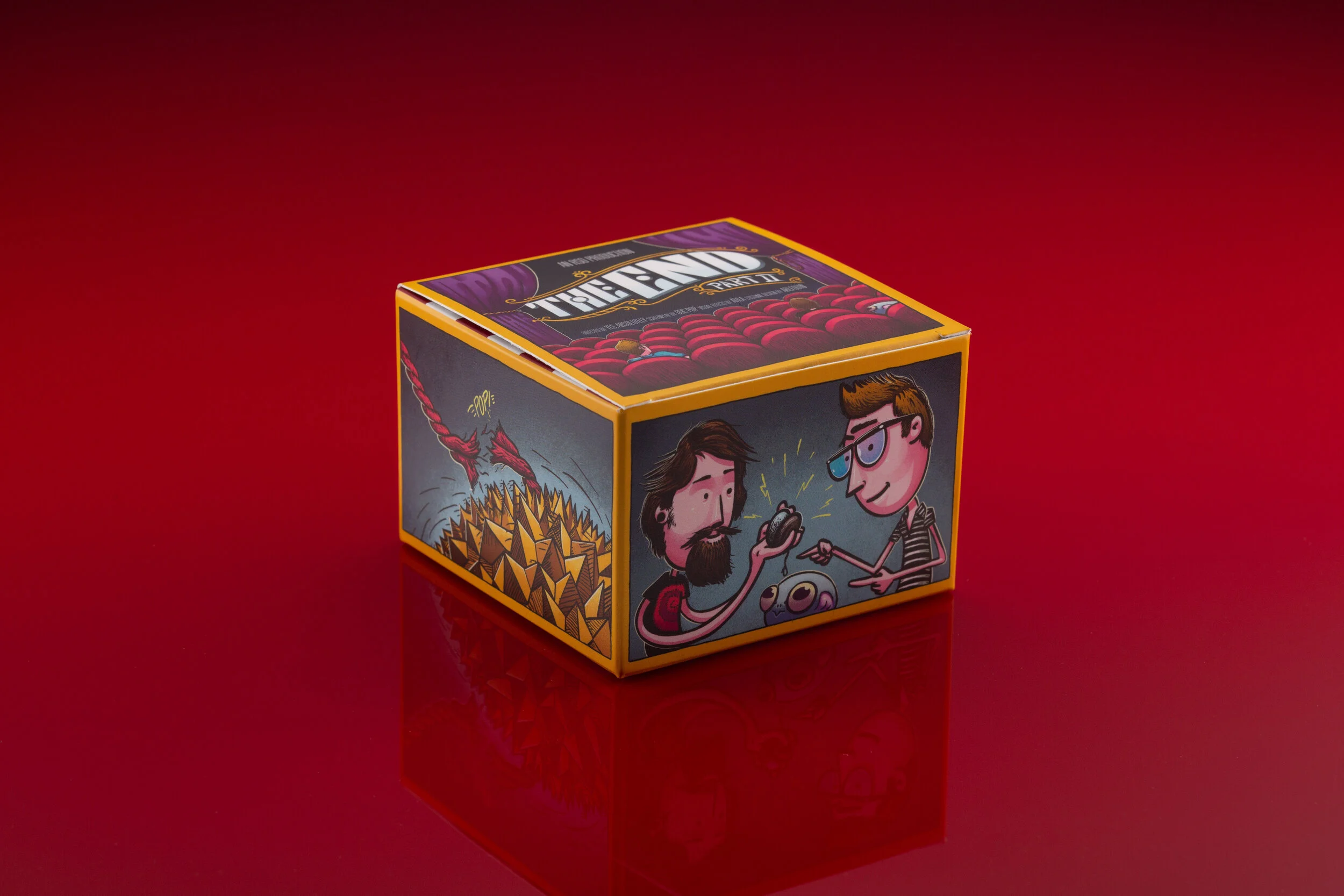
For The End Part II, the artwork and engraving were brought together through a cinematic theme. The concept presents the box as a film documenting the creation of The End - from the original Eetsit and its modifications to the problems and solutions that followed. Doc Pop created the artwork, while ATILA supplied the colour.
Names belonging to Sonny, Kiya, Nick, Phil, Taka, Doc Pop and Elvin are hidden throughout the cover. The rectangular elements from the original hub engraving were subtly transformed into strips of film, while the logo references the album of the same name by The Doors. The accompanying popcorn enamel pin completes the cinema presentation.


Can you find the names of Sonny, Kiya, Nick, Phil, Taka, Doc Pop and Elvin on the cover art?




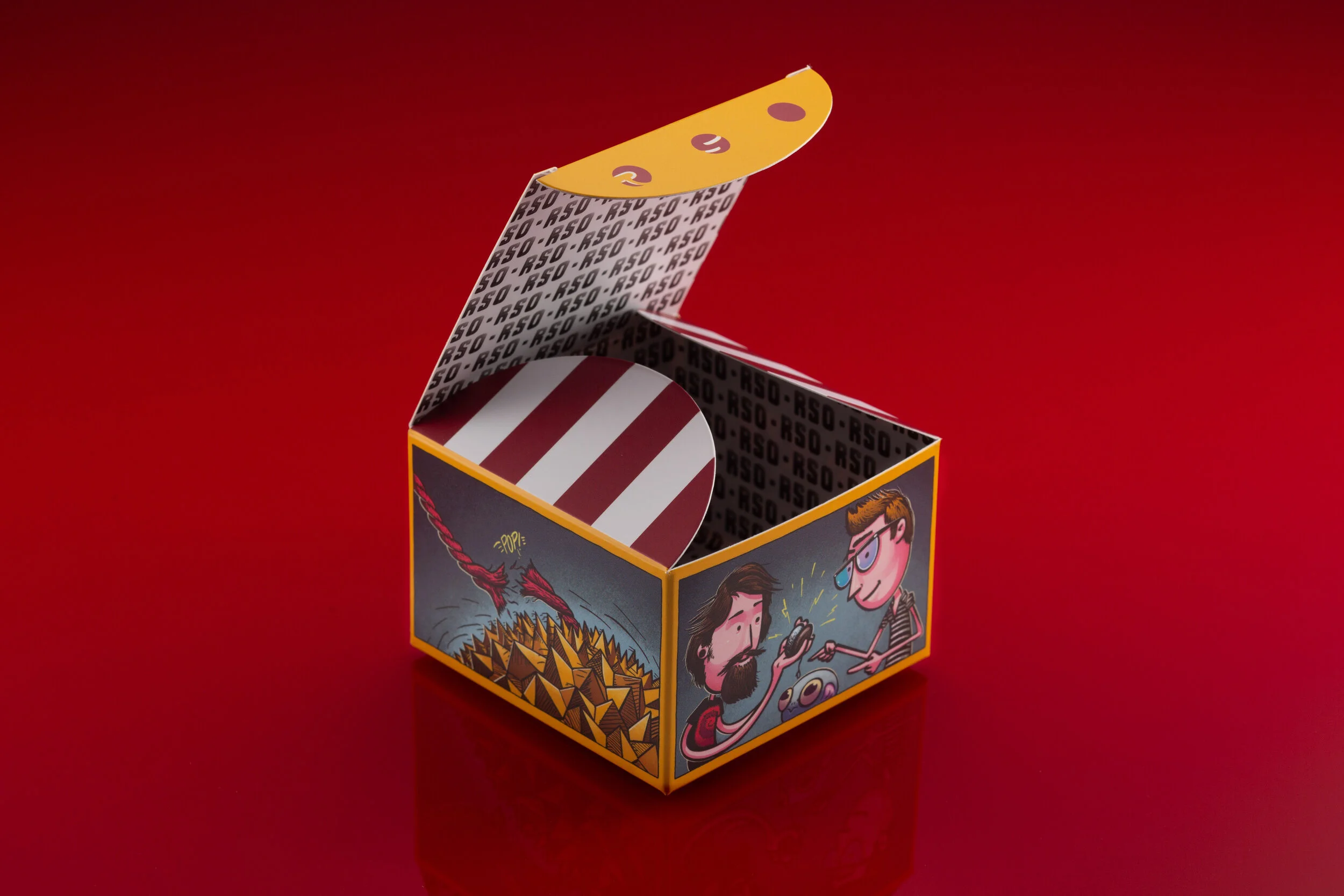

WHAT’S IN THE BOX
POPCORN ENAMEL PIN
A PAIR OF 19MM MAROON TYPE 40 LANDING PADS RESPONSE
CUSTOM STRING BY ARLEQUIN STRINGS

Sketch by Doc Pop.

The custom string was produced by Arlequin, an RSO collector from France. Its unusually thick construction combines 33% polyester with 66% nylon, providing greater durability than conventional bulk polyester string while remaining suitable for slacks and whips.


THE END - PART II (FINALE)
Demand for The End Part II has been overwhelming. Since it was announced, I have received countless messages asking the same question: Why were so few made?
The answer is that I never intended to make so few. A substantially larger run was ordered, but most of the anodised yo-yos were rejected as B-grades. The problem was attributed to substandard 7068 aluminium stock. My machinist has graciously agreed to reproduce the affected quantity, while the rejected halves will be recycled. This first release is therefore called Prelude.
The replacement run will become the Finale. I am taking the opportunity to refine the design with subtle revisions to the Schmoove grooves and slightly rounder rims. The Finale will remain numbered and will continue to be machined from 7068 aluminium. The differences will be subtle but deliberate. Prelude represents the first interpretation of The End Part II; Finale will carry the design to its intended conclusion.
Collectors who want the complete story will find reasons to own both. If you missed the Prelude, however, the performance is far from over. There will be enough tickets to the Finale for everyone.
The End is only getting started.